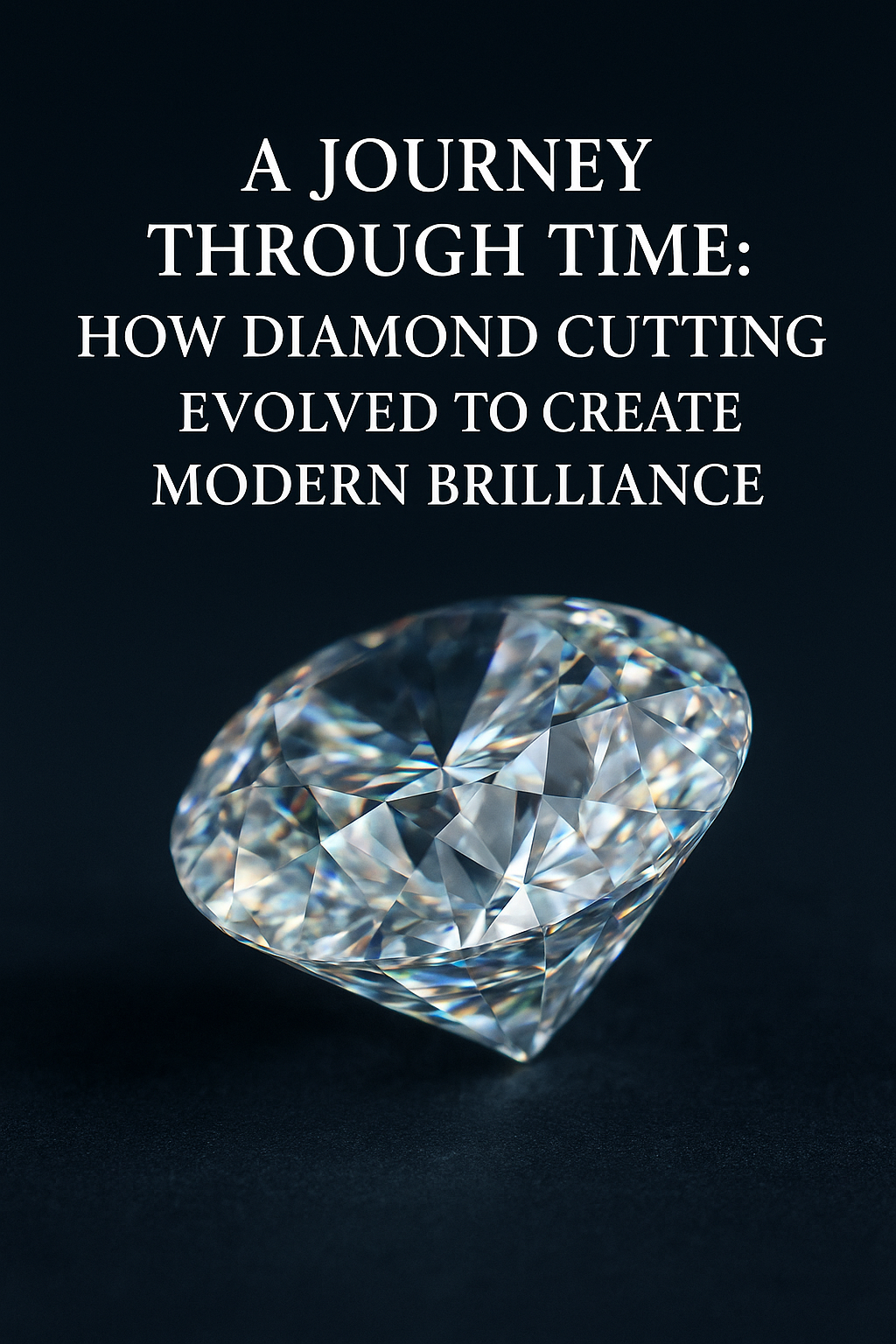
A Journey Through Time: How Diamond Cutting Evolved to Create Modern Brilliance
Diamonds have always symbolized strength, purity, and timeless beauty—but the way they shine today is the result of centuries of artistry and innovation. Let’s walk through history and see how diamond cutting evolved from simplicity to the dazzling brilliance we admire now.
14th Century – The Point Cut
It all began with the Point Cut—the first true diamond cut that followed the natural octahedral shape of the rough stone. Simple, geometric, and full of medieval symmetry, this design reflected purity and royal power.
15th Century – The Table Cut
The invention of the rotary cutting wheel changed diamond cutting forever. By polishing a flat surface, or “table,” cutters made light reflect within the stone for the first time—marking the beginning of sparkle.
Late 15th Century – The Old Single Cut
Adding small corner facets created a softer play of light. This was a leap forward in the art of cutting and hinted at the brilliance yet to come.
16th Century – The Rose Cut
Perhaps the most romantic cut in history, the Rose Cut featured a flat base and domed top with 24 triangular facets—made to glow under candlelight. Even today, it remains beloved for its antique charm and gentle shimmer.
17th Century – Mazarin & Peruzzi Cuts
Cardinal Mazarin introduced the 17-facet crown, birthing the “brilliant style.” Later, Vincenzo Peruzzi refined it into a 57-facet design—the foundation of today’s modern brilliance.
18th Century – The Old Mine Cut
The Old Mine Cut defined the era’s elegance—deep pavilion, high crown, small table, and open culet. Each diamond was hand-cut under candlelight, radiating a warm, soulful glow unique to that period.
18th Century – The Marquise Cut
Commissioned by King Louis XV of France, this elongated shape was inspired by the smile of his mistress, the Marquise de Pompadour—a royal love story forever captured in stone.
19th Century – The Old European Cut
Rounder and more symmetrical than the Old Mine, the Old European Cut was crafted to dazzle under gaslight, bridging classic craftsmanship with modern symmetry.
Late 19th–Early 20th Century – Transitional Cuts
As tools advanced, cutters began refining angles and proportions for better light performance. These “Transitional Cuts” paved the way for the perfected modern round design.
1919 – The Modern Round Brilliant
In 1919, mathematician Marcel Tolkowsky transformed the art of cutting by creating a 58-facet formula that maximized brilliance and fire. His legacy lives on—the Modern Round Brilliant remains the world’s most popular and scientifically precise diamond cut.
✨ Where Craft Meets Innovation
At VIKASI Lab Diamond Jewelry, we honor centuries of craftsmanship while embracing modern technology. Each lab-grown diamond captures the brilliance of history—ethically, beautifully, and sustainably.
Because true brilliance never fades—it evolves.
